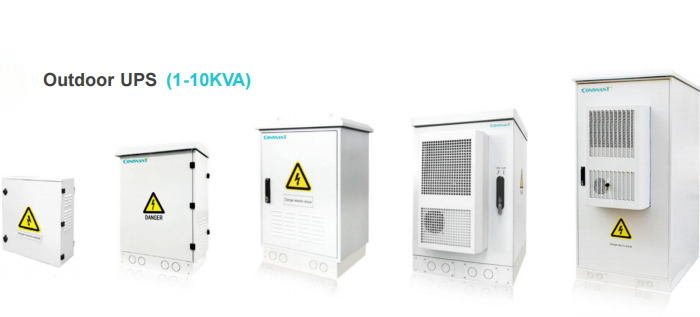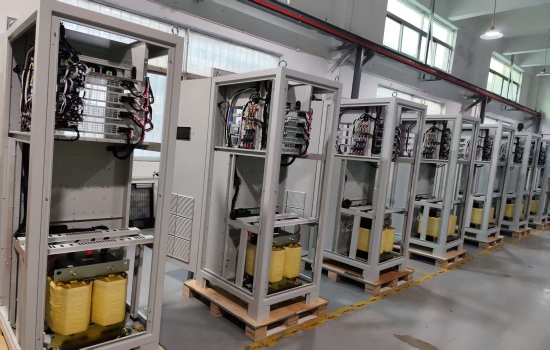
Onduleur extérieur
  • Pole‑Mounted vs Floor‑Mounted Outdoor UPS: Which Fits Your Site? Pole‑Mounted vs Floor‑Mounted Outdoor UPS: Which Fits Your Site? Nov 17, 2026
    Introduction Outdoor UPS systems deliver critical backup power for unmanned remote sites: telecom micro‑base stations, roadside surveillance, port monitoring, highway signal equipment and coastal industrial facilitiesConsnant. When specifying outdoor UPS cabinets, one core decision stands out: pole‑mounted or floor‑mounted (ground‑mount) configuration. Many project engineers only compare kVA ratings and IP protection grade, ignoring mounting form factor. Wrong mounting selection leads to extra civil construction cost, insufficient load‑bearing risk, poor heat dissipation or difficult field maintenance. CONSNANT outdoor UPS portfolio supports both pole‑mounted and floor‑mount installation. This article compares their pros‑cons, site requirements, typical scenarios and helps you define clear specifications for your tender documents. What is Pole‑Mounted Outdoor UPS Pole‑mounted outdoor UPS is compact outdoor power cabinet fixed to utility poles, communication towers or monopoles via heavy‑duty mounting brackets. It is designed for sites without available floor space. Core Advantages of Pole‑Mounted Outdoor UPS Zero civil foundation work: No concrete base required, fast on‑site deployment; ideal for sites where ground occupation is restricted. Space‑saving: Mounted at height, avoids ground flood, debris and animal damage. Rapid roll‑out: Perfect for dense‑distribution micro‑sites like 5G small cells, traffic cameras, roadside IoT devices. Key Limitations & Site Constraints Weight & capacity ceiling: Limited by pole mechanical load‑bearing capacity. Usually fit low‑to‑medium power (typically under 10kVA), compact battery banks. Not for large‑capacity long‑runtime backup. Higher requirements for brackets: Anti‑corrosion metal brackets are mandatory for coastal / high‑humidity regions to resist salt‑fog corrosion. Maintenance accessibility: Technicians need lifting tools for high‑pole installation, increasing routine service difficulty. CONSNANT pole‑mount outdoor UPS & hybrid telecom power cabinets (OD‑TRSS‑48300 series) reach IP55/IP56 ingress protection, with optional heater, cooling fan or air‑conditioner thermal modules, supporting lithium‑ion or lead‑acid battery integration for remote pole‑top sitesConsnant. Anti‑corrosion pole‑mount kits are available for coastal C4/C5 corrosive environments. What is Floor‑Mounted (Ground‑Mount) Outdoor UPS Floor‑mount outdoor UPS stands on concrete foundation, deployed at ground level. These full‑size outdoor cabinets integrate UPS host, large‑capacity battery string, PDU distribution, comprehensive thermal management and SNMP remote monitoring inside one single cabinet or multiple cabinets. Core Advantages of Floor‑Mounted Outdoor UPS Higher power & bigger battery capacity: Support wide power range, from several kVA up to industrial‑grade hundreds of kVA. Realize long backup runtime with large battery banks. Excellent maintainability: Ground‑level access; technicians can complete inspection, battery replacement and troubleshooting without high‑altitude work. Rich expandability: Easy to expand battery capacity, add auxiliary monitoring modules, integrate solar hybrid power solutions. Strong environmental adaptability: Full‑scale anti‑corrosion cabinet options (galvanized steel, 304 /316 stainless steel), suitable for coastal, desert, heavy‑industrial harsh sites. Key Limitations & Site Constraints Civil construction needed: Must build solid concrete foundation; site survey and construction cycle add project lead‑time. Occupies ground footprint: Require available land space, not applicable for sites with extremely limited ground area. Flood risk concern: Need elevation design or drainage treatment for low‑lying flood‑prone locations. CONSNANT floor‑mount outdoor UPS CNW series adopts all‑in‑one cabinet design, IP55 / IP56 protection grade, integrated air‑conditioning / heating thermal control, CE, ISO9001, ISO14001, ISO45001 certified. Widely used for macro telecom base station, port power backup, substation auxiliary power and edge data centre outdoor power projects. Side‑by‑Side Comparison Table: Pole‑Mounted VS Floor‑Mount Outdoor UPS   Comparison Item Pole‑Mounted Outdoor UPS Floor‑Mounted (Ground‑Mount) Outdoor UPS Installation Condition Utility pole / communication tower with qualified load‑bearing; no concrete base Need solid concrete foundation, available ground space Typical Power Range Low‑medium power, generally ≤10kVA Wide range: small kVA to hundreds kVA industrial grade Battery & Backup Time Compact battery, short‑medium backup runtime Large‑capacity battery pack, support long backup duration Civil Work Minimal, fast deployment Require civil construction, longer project cycle O&M Difficulty High‑altitude operation required Ground‑level, easy maintenance Space Requirement No ground space needed Occupies ground area Recommended Scenarios 5G small cell, traffic camera, roadside IoT, scattered micro‑sites Macro base station, port, industrial site, edge data centre, long‑backup requirement CONSNANT Typical Product OD‑TRSS series hybrid telecom power, compact CNW pole‑mount cabinet CNW outdoor UPS series, large‑size outdoor integrated power cabinet How to Decide Which Solution Your Site Needs Choose Pole‑Mounted Outdoor UPS if these conditions apply: ✅ Site has usable communication / utility pole with verified mechanical load capacity ✅ Ground space is very limited, cannot build concrete foundation ✅ Load power is low‑medium, no demand for ultra‑long backup time ✅ Large‑quantity scattered micro‑sites deployment (small‑cell, surveillance cameras, roadside sensors) Note: Must confirm pole load‑bearing value before procurement; specify anti‑corrosion mounting brackets for coastal salt‑spray environments. Choose Floor‑Mounted Outdoor UPS under these conditions: ✅ Sufficient ground area and allow concrete foundation construction ✅ Require high‑power UPS or long battery backup runtime ✅ Frequent on‑site maintenance work expected ✅ Harsh coastal / desert industrial sites, macro base station and edge data centre CONSNANT Custom Outdoor UPS for Two Mounting Forms As a professional outdoor power manufacturer, CONSNANT provides configurable outdoor UPS solutions supporting pole‑mount, floor‑mount and wall‑mount three installation forms for global projects: Flexible cabinet material options: galvanized steel heavy‑duty anti‑corrosion coating, optional upgrade to 304 /316L stainless‑steel shell for coastal C4 / C5 sites. Uniform high‑grade enclosure: IP55 / IP56 dust‑water protection, double‑layer EPDM weather‑resistant sealing gasket. Modular thermal management: intelligent fan, heater or cabinet air‑conditioner optional, adapt temperature range‑40℃ ~ +60℃. Intelligent monitoring: built‑in SNMP / dry‑contact alarm, remote real‑time status monitoring for unmanned stations. Complete certification portfolio: CE, ISO 9001, ISO14001, ISO45001, satisfying overseas bidding requirements. FAQ Q1: Can I retrofit a floor‑mount outdoor UPS for pole‑mount installation? A: Not recommended. Floor‑mount cabinets have larger total weight. Even with self‑made brackets, it will exceed pole load‑bearing limit, bringing safety hazard. You should select factory‑certified pole‑mount model. Q2: Does pole‑mount outdoor UPS support solar hybrid power? A: Yes. CONSNANT OD‑TRSS series pole‑mount hybrid power integrates MPPT solar charge controller, suitable for off‑grid or poor‑grid remote pole sites. Q3: For coastal salt‑fog sites, any extra requirements for pole‑mount hardware? A: Specify 316 stainless‑steel mounting brackets, bolts and fasteners. Ordinary carbon‑steel brackets will suffer rapid corrosion under coastal chloride environment. Conclusion Pole‑mounted and floor‑mount outdoor UPS are not simply "good vs bad". Your final selection must be based on site survey data: pole load‑bearing, available ground space, required UPS power, backup runtime, maintenance frequency and local environmental corrosivity.   Improper mounting selection may create hidden safety risks and extra project cost. CONSNANT technical team can provide site‑oriented outdoor UPS recommendation. Please visit: https://www.consnant.com/outdoor‑ups‑solutions or send email sales@consnant.com for customized technical proposal.
  • Outdoor UPS Cabinet Corrosion Protection: What Should Coastal Sites Specify? Outdoor UPS Cabinet Corrosion Protection: What Should Coastal Sites Specify? Nov 10, 2026
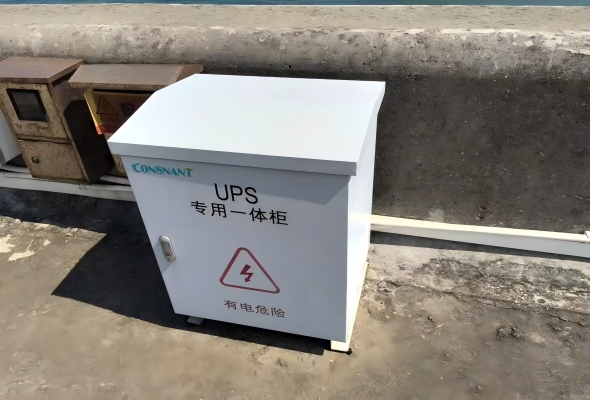
    Introduction Coastal deployment for outdoor UPS cabinets brings unique environmental challenges: salt‑laden sea wind, high humidity, chloride deposition and UV radiation can gradually erode cabinet shells, fasteners, sealing seams and internal power components. Many project engineers mistakenly believe a high‑level IP rating is sufficient for coastal anti‑corrosion. However, IP rating only measures dust‑water ingress protection, and cannot replace corrosion‑resistant material, surface finishing and verification testing. Without proper specifications, premature rust, paint peeling and cabinet failure will cause costly downtime for telecom base stations, port automation, coastal data sites and seaside industrial facilities. When you source outdoor UPS systems for coastal sites, what exact anti‑corrosion requirements should you write into your technical specification sheet? This article breaks down core specification points and introduces CONSNANT outdoor UPS cabinet proven for harsh seaside environments. Key Specification Items for Coastal Outdoor UPS Cabinets 1. Cabinet Base Material Selection Chloride ions from sea salt are the primary driver of coastal cabinet corrosion. Different base metals deliver huge performance gaps: Galvanized cold‑rolled steel: Cost‑effective for inland outdoor sites; for coastal use, must match high‑performance duplex anti‑corrosion coating system, otherwise rust will emerge quickly. 304 stainless steel: Suitable for mild coastal areas far from shoreline. Not recommended for sites within several kilometers of coastline, as chloride may trigger pitting corrosion over time. 316 /316L stainless steel: Preferred material for high‑salinity coastal and near‑shore locations. Molybdenum ingredient enhances resistance against chloride‑induced corrosion. CONSNANT outdoor UPS & telecom power cabinets support customizable cabinet material: galvanized steel with heavy‑duty anti‑corrosion spray, optional 304 / 316 stainless‑steel shell for coastal and marine‑grade projects. 2. Surface Coating & Treatment Standards Material alone cannot guarantee long‑term anti‑corrosion. Surface finishing must be clearly specified in procurement documents: Pre‑treatment: Complete degreasing, phosphating and passivation before spraying. Outdoor‑grade powder coating / duplex coating system; define dry film thickness requirement. Weld seams, sharp edges and cut corners need full coverage; these positions are typical corrosion weak‑points. CONSNANT coastal‑targeted cabinets adopt galvanized substrate plus professional outdoor anti‑corrosion spraying process, completed strict salt‑spray ageing test. Real‑world coastal project cases verify no obvious rust after multi‑year field running. 3. Hardware, Fastener & Galvanic Corrosion Prevention Many corrosion failures occur not on main cabinet panels but on screws, hinges, lock assemblies and cable glands: All exposed fasteners shall adopt stainless‑steel hardware (316 recommended for severe coastal sites). Avoid direct contact between dissimilar metals to prevent galvanic corrosion under damp salt‑air atmosphere. Double‑layer EPDM weather‑resistant sealing gasket; ordinary rubber will age and crack quickly under coastal UV & salt fog. 4. Protection Grade, Thermal Management & Cabinet Structure Important reminder: IP55 / IP56 dust‑water protection ≠ anti‑corrosion performance, but it is a necessary foundation for coastal cabinet reliability. Specify requirements below: Minimum enclosure rating: IP55 or IP56, preventing salt‑mist, rain and dust entering cabinet interior. Internal temperature control: optional cabinet air‑conditioner or heater module, avoid high‑humidity condensation inside accelerating electronic part corrosion. Reasonable drainage design: drain holes for condensed moisture inside cabinet. CONSNANT Outdoor UPS Cabinet series reaches IP55 / IP56 protection level. Integrated thermal management including cabinet air‑conditioning, heating and heat dissipation fan modules, supporting ground‑mount, pole‑mount and wall‑mount installation for seaside base stations and coastal industrial sites. H3|5. Mandatory Test & Certification Requirements Add these test clauses into technical tender documents: Neutral Salt Spray Test (NSS): Define testing hours according to coastal corrosivity grade (reference ISO 12944 corrosion class C4 / C5 for coastal environment). Request supplier provide third‑party salt‑spray test report for cabinet assembly, not only raw‑material certificate. Verify product certificates including CE, ISO 9001, ISO 14001, ISO 45001 quality‑environment‑occupational‑health management system certifications. H2|CONSNANT Outdoor UPS Solution for Coastal Harsh Sites As a China‑based manufacturer specialized in outdoor UPS, telecom power cabinet and energy‑storage power solution, CONSNANT delivers fully customized outdoor power system for coastal telecommunication base station, port, coastal power station and seaside industrial projects. Core highlights for coastal projects: Flexible cabinet material options: galvanized steel with heavy‑duty anti‑corrosion coating, upgradeable to 304 /316 stainless steel enclosure. IP55 / IP56 sealing cabinet, double‑layer weather‑resistant sealing structure, passed salt‑spray ageing verification from lab and real‑site coastal deployment. All‑in‑one integration: UPS host, lithium‑ion / lead‑acid battery bank, PDU distribution, intelligent temperature control and SNMP remote monitoring inside single cabinet, adapting unmanned coastal site operation. Full certification portfolio: CE, ISO series certification, supporting overseas project bidding requirements. Custom service: adjust cabinet dimension, cooling configuration, anti‑corrosion grade according to local coastal salinity, temperature and site layout. FAQ Q1: If a cabinet is IP56‑rated, does it mean it will resist coastal salt‑fog corrosion? A: No. IP rating describes protection against water jet and dust. Corrosion resistance depends on substrate material, coating, fastener material and salt‑spray test performance. High IP grade cannot replace anti‑corrosion specification work. Q2: 304 vs 316 stainless steel: which one to pick for coastal sites? A: 304 stainless steel works for mildly‑coastal zones far away from surf. For locations within several kilometers of seashore with heavy salt‑spray exposure, specify 316 / 316L stainless‑steel cabinet and hardware for long service life. Q3: What typical applications require anti‑corrosion outdoor UPS cabinets in coastal regions? A: Coastal 5G telecom base station, port monitoring & automation system, seaside wind‑solar hybrid station, coastal substation auxiliary power, coastal highway monitoring equipment, offshore island backup power system. Conclusion Coastal site outdoor UPS cabinet anti‑corrosion is a system engineering covering material selection, surface treatment, hardware matching, structural design and laboratory verification test. Relying only on IP grade or supplier verbal promises creates hidden operational risks. Project buyers should clearly write material grade, coating specification, fastener requirement and salt‑spray test criteria into technical specifications. CONSNANT provides one‑stop customized outdoor UPS cabinet & power system for coastal harsh‑environment projects. Visit our outdoor UPS solution page: https://www.consnant.com/outdoor‑ups‑solutions or email sales@consnant.com for detailed technical proposal.
  • How to Plan Modular UPS Capacity and N+X Redundancy for a Data Center? How to Plan Modular UPS Capacity and N+X Redundancy for a Data Center? Nov 02, 2026
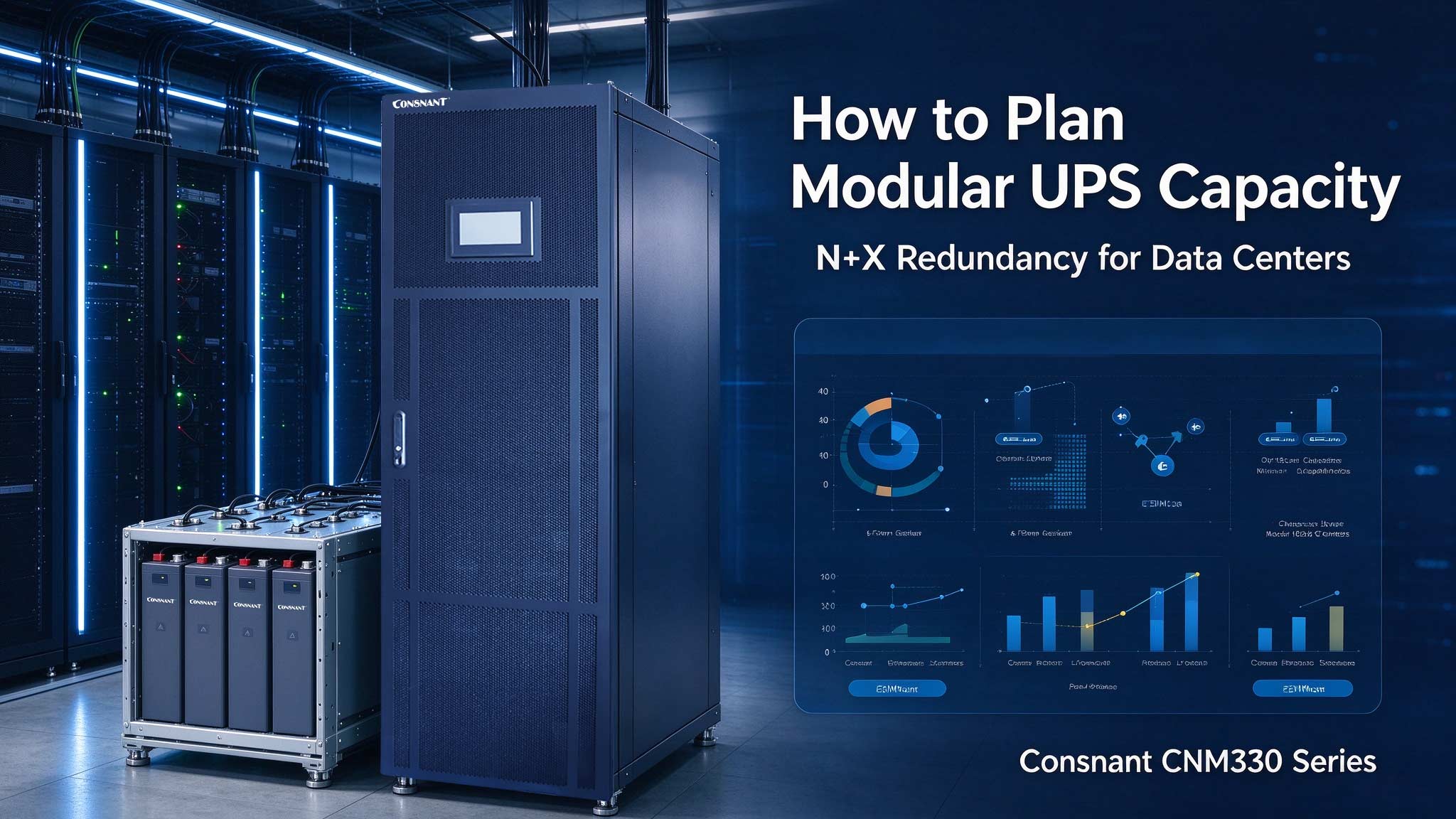
    Modern enterprise, colocation and AI‑powered data centers demand flexible, high‑availability uninterruptible power supplies. Modular UPS systems allow incremental capacity expansion and built‑in module‑level N+X redundancy, which outperforms traditional monolithic UPS for fast‑growing IT environments. However, improper capacity calculation or wrong redundancy configuration will cause waste of investment, low operating efficiency or hidden risks of power outage. This article walks you through practical workflows for modular UPS sizing and N+X redundancy design, with real‑world reference to Consnant CNM330 series modular online UPS for data‑center‑grade power protection. Step1: Calculate Real Critical IT Load (Avoid Over‑Sizing or Under‑Sizing) Capacity planning must start from measured real‑world load instead of theoretical nameplate value. Many data‑center projects over‑provision UPS capacity blindly and suffer poor partial‑load efficiency. Sum up critical real power (kW), not just kVA. Include servers, storage, network switches, and also UPS‑supported cooling equipment. For AI GPU racks, use sustained operating power instead of peak instantaneous value. Apply diversity factor: Not every rack runs at full power simultaneously. Typical diversity factor: General enterprise racks: 0.7‑0.85 AI / GPU intensive racks: 0.9‑1.0 Storage array racks:0.8‑0.9 Reserve reasonable future growth margin: Keep the normal operating load within 60%‑80% of total UPS usable capacity. This range balances system efficiency and expansion space. Important note: Do NOT double‑count redundancy capacity as growth headroom. Redundancy modules are for fault tolerance, not for future IT load growth. Consnant CNM330 modular UPS adopts 50 kW high‑density hot‑swap power module, supports flexible capacity stacking from 50 kW up to 600 kW per cabinet, matching phased deployment of small‑medium IDC and large‑scale AI data centers. Step2: Understand N, N+1, N+2, N+X Redundancy for Modular UPS N+X redundancy means deploying N working modules for carrying real‑time load, plus X spare redundant modules. X stands for quantity of backup modules that can bear load when modules fail or are pulled out for maintenanceSchneider ...。 N configuration: Exactly enough modules for present load, zero spare. No fault tolerance. Only suitable for non‑critical edge sites. N+1: 1 spare redundant module. If one module fails or needs hot‑swap maintenance, remaining N modules can fully support critical load. Fits Tier‑II / basic Tier‑III enterprise data centers, most popular cost‑effective solution. N+2: Two spare modules. Tolerate two‑module simultaneous failure or maintain two modules at the same time. Target for high‑reliability Tier‑III / Tier‑IV mission‑critical colocation and financial data centers. 2N / 2(N+1): Dual independent UPS bus architecture. Each bus can independently bear full critical load, highest fault‑tolerance for Tier‑IV facilities. Consnant CNM330 series supports configurable N+X redundancy via LCD touch screen. System will trigger alarm when load exceeds redundancy protection threshold, and can reach system availability up to 99.999% under N+2 setup, MTBF up to 250,000 hours. Power modules support online hot‑swap: technicians replace faulty modules without shutting down IT loads. Up to 4 cabinets can be paralleled for larger‑scale deployment. Step3: Key Factors to Determine Your X Value in N+X Before locking your redundancy scheme, evaluate these four dimensions: Uptime Tier requirement: Match Uptime Institute Tier standards. Tier‑III requires concurrent maintainability; Tier‑IV demands fault‑tolerant power path. Business outage loss: How much financial loss will be caused by power interruption? Financial, medical and core AI computing facilities usually choose N+2 or higher. On‑site maintenance condition: If local engineer response is slow, increase X to reduce maintenance risk window. Total‑Cost‑of‑Ownership(TCO): Each additional redundant module raises CAPEX, but lowers risk of downtime loss. Balance reliability and investment budget. Common Pitfalls in Modular UPS Capacity & Redundancy Design ❌ Confuse kVA and kW, ignore actual output power factor. Modern IT loads draw real power(kW). Consnant CNM330 reaches output power factor 1.0 to deliver more real power within same cabinet footprintConsnant. ❌ Treat redundant X‑modules as expansion capacity. When IT load grows, you still need to add working N‑modules, cannot consume redundancy spare capacity. ❌ Run modular UPS at ultra‑low load (<30% rated). Too‑light load reduces overall system efficiency. Modular UPS should shut idle redundant modules properly if supported. ❌ Ignore battery matching after UPS capacity upgrade. After adding power modules, verify charging current, battery bank voltage and backup runtime together. Consnant CNM330 equips intelligent battery management system with adaptive charging current adjustment for different battery groups. Practical Configuration Example for Consnant CNM330 Modular UPS Scenario: Enterprise Tier‑III data center, real critical IT load = 150 kW, 50 kW per power module. Minimum working N modules = 3 units (3 × 50 kW =150 kW) Require N+1 redundancy → total installed modules: 4 units, total cabinet capacity:200 kW Normal operating load rate: 150÷200 =75%, falls within optimal 60‑80% operating window. If upgrade to high‑security financial data center requirement, switch to N+2: total 5 modules (3+2), total capacity 250 kW. Multiple CNM330 cabinets support parallel expansion, so data centers can purchase initial modules matching current load and add power modules later as business expands, avoiding large‑sum one‑time upfront investment. Additional Site Checks Before Final Deployment Confirm cabinet floor load, rack space, ventilation and heat dissipation condition for modular UPS cabinet. Confirm communication interface: SNMP, Modbus‑TCP, dry‑contact alarm for integrating into data center DCIM monitoring platform. Consnant CNM330 supports above industrial standard interfaces. Validate backup runtime requirement, select proper VRLA or lithium‑ion battery configuration. Conclusion Modular UPS brings outstanding scalability and redundancy advantages, yet reliability does not simply come from buying more modules. Correct workflow: measure real IT load → set reasonable operating load percentage → define N working modules → select X redundancy number according to tier & business risk → verify battery, monitoring and site environment. Consnant CNM330 modular UPS series provides flexible N+X redundant architecture, hot‑swappable power modules and high power‑density design, helping data‑center operators achieve phased construction and balanced TCO between reliability and cost. FAQ Q1: Is N+1 always enough for Tier‑III data center? A1: Not absolutely. N+1 satisfies concurrent maintainability on module‑level, but you still need to check distribution path, bypass and battery system design to fully meet Tier‑III criteria. Q2: Can I add redundant modules later after the modular UPS cabinet is deployed? A2: Yes for Consnant CNM330 series. Empty slots inside cabinet reserve space for future hot‑swap power‑module insertion, no cabinet replacement required. Q3: What is the difference between module‑level N+X and traditional whole‑unit N+1 parallel? A3: Modular N+X implements redundancy inside one cabinet via power modules, smaller footprint, maintenance without whole‑unit shutdown; traditional N+1 parallel uses complete independent UPS cabinets, fits 2N dual‑bus large‑scale architecture. Q4: Does CNM330 modular UPS support lithium‑ion battery?   A4: Yes. The intelligent charging algorithm supports both lead‑acid VRLA and lithium‑iron phosphate battery banks, with adjustable charge parameters.
  • Replacing an Industrial UPS: What Information Should a Plant Gather Before Selecting a Replacement? Replacing an Industrial UPS: What Information Should a Plant Gather Before Selecting a Replacement? Oct 28, 2026
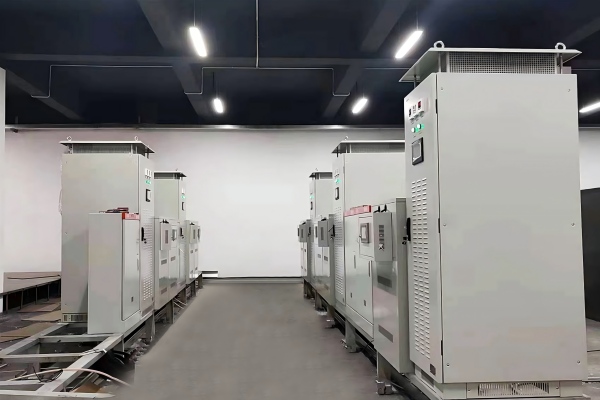
    For manufacturing plants, chemical facilities, water treatment sites and process automation workshops, the industrial UPS protects mission-critical loads: DCS control systems, PLC hosts, sensors, safety interlock devices and monitoring instruments. An aging UPS faces rising failure risk, spare part shortages and low efficiency. Rushing into replacement without a complete data survey often leads to mismatched capacity, incompatible wiring, insufficient backup runtime or expensive rework. Before selecting a replacement industrial online UPS, maintenance and electrical teams must collect structured site data. This checklist helps you define requirements clearly and select a reliable industrial UPS solution such as Consnant CNG low-frequency industrial UPS and CNH high-frequency industrial UPS series. 1. Existing UPS & Load Profile Data Start by auditing the current UPS and real load conditions, not only the nameplate values. Old UPS model, rated kVA/kW, output power factor, phase configuration (3/3, 3/1, 1/1), topology (online double conversion) Actual measured load (not just nameplate sum): steady-state load, inrush current from motors, periodic surge load Critical load list: DCS, PLC, emergency instruments, SCADA, actuators; separate non-critical loads that can be removed from the UPS bus Load tolerance: voltage sag tolerance, harmonic sensitivity, whether zero transfer time is mandatory Future expansion margin: 20%–30% spare capacity is recommended for new production lines or additional control cabinets Consnant industrial UPS supports output power factor 1.0, which delivers more real power for modern switching power loads common in automation control rooms. The CNG330 low-frequency industrial UPS is designed to withstand heavy inrush and short-circuit events typical of factory environments. 2. Grid & Electrical Interface Information Industrial sites usually suffer unstable grids: voltage flicker, frequent sags, harmonics and phase imbalance. These parameters decide the acceptable input window, rectifier type and harmonic requirements. Nominal voltage: 380/400/415VAC, 220/230VAC; actual long-term measured input voltage range Frequency range, grid THDi, harmonic source location (VFD, welding machines) Input and output wiring: cable size, existing bypass path, maintenance bypass, single-line diagram Protection coordination: upstream MCCB rating, earth fault scheme, short-circuit capacity at the power room Local compliance standards: IEC 62040, CE, ISO and site internal electrical codes Consnant high-frequency CNH series adopts ultra-wide input voltage range, which reduces battery discharge frequency and extends battery life for sites with poor grid quality. The 12-pulse rectifier option suppresses low-order harmonics for harmonic-sensitive process plants. 3. Backup Runtime & Battery System Requirements Battery is the biggest variable in industrial UPS TCO. Do not default to the old runtime. Required backup time: short ride-through (5–15 min) for orderly shutdown; long runtime (30 min to several hours) for continuous process Battery type compatibility: lead-acid VRLA or LiFePO4 lithium battery Existing battery cabinet size, DC voltage, charging current limits Battery environment: temperature, ventilation, fire control rules, battery recycling requirements Recharge time target after outage Consnant’s intelligent battery management system automatically switches float charge and equalized charge, slowing battery aging and extending battery service life by over 40%. External battery cabinets can be configured flexibly to meet customized backup duration. 4. Physical Site & Environmental Constraints Many UPS retrofit projects fail because engineers only check drawings instead of the real room conditions. UPS room dimensions, floor load capacity, door width, lifting path, elevator limits Ambient temperature, humidity, dust, corrosive gas, condensation risk; IP protection requirement Heat dissipation: air conditioning capacity, ventilation route, noise limit for control building Installation footprint: traditional tower or compact rack/modular layout Working window for replacement: whether live cutover is needed to avoid production stop 5. Communication, Monitoring & Maintenance Specifications Modern industrial UPS must integrate into plant SCADA and centralized monitoring platforms. Required communication protocols: Modbus-RTU, Modbus-TCP, SNMP, dry contact alarm Remote monitoring platform, local HMI display requirement, fault alarm notification method Maintenance access: front service, hot-swap module, online parallel expansion capability Service expectation: local after-sales support, spare parts lead time, preventive maintenance plan Consnant industrial UPS supports standard industrial communication interfaces and parallel redundancy. Multiple units can run in parallel for N+1 redundancy, enabling online capacity expansion without shutting down critical control systemsMade-in-Ch.... 6. Budget, TCO & Cutover Risk Plan Capital budget and long-term TCO comparison: efficiency loss of old UPS, battery replacement cycle, maintenance cost Cutover strategy: hot swap, temporary bypass UPS, scheduled shutdown window Disposal plan for old UPS and waste batteries following local environmental regulations Matching Consnant Industrial UPS Series After Data Collection After you gather all the above information, you can match the correct product family: CNG Low Frequency Industrial Online UPS: for heavy industry, harsh grid, high overload, DCS/boiler/chemical control systems CNH High Frequency Industrial Online UPS: compact footprint, high efficiency, for automation workshops, intelligent factory control rooms Modular UPS: for phased expansion, N+1 redundant power rooms, data and central control centers Final Tips for Plant Teams UPS replacement is not a simple “same-for-same swap”. Old units may be oversized or undersized for today’s load profile. A complete site survey report allows your UPS supplier like Consnant to provide an optimized quotation, correct cabinet layout and safe cutover scheme. FAQ Q1: Can I directly replace the industrial UPS with the same kVA as the old one? A1: Not recommended. You need to measure the real running load, check power factor and add expansion margin. The old UPS may run at low load with poor efficiency or be overloaded by newly added control equipment. Q2: What is the advantage of low-frequency industrial UPS for process plants? A2: Low-frequency UPS has stronger overload and short-circuit tolerance, better anti-interference performance, suitable for sites with motor loads and frequent grid disturbances. Q3: Does Consnant industrial UPS support lithium battery? A3: Yes. Consnant industrial online UPS is compatible with lead-acid and LiFePO4 batteries, with adjustable charging curves for different battery chemistries.
  • What Maintenance Does an Industrial UPS Need? How Can Factories Reduce Downtime and Battery Failures? What Maintenance Does an Industrial UPS Need? How Can Factories Reduce Downtime and Battery Failures? Oct 26, 2026
    Industrial online UPS is the power safety backbone for petrochemical plants, power plant DCS systems, production lines and lab test equipment. Unplanned UPS failures cause costly production shutdowns, and 75‑80% of industrial UPS outages root in insufficient maintenance and premature battery faults. Even high‑grade hardware such as the CONSNANT CNI310 & CNI330 series industrial online UPS (10‑300KVA, IP42/IP54 rated, ISO‑IEC‑CE certified) cannot escape wear‑and‑tear in dusty, high‑temperature factory environments. This blog breaks down mandatory maintenance items, explains battery failure triggers, and shares actionable strategies to minimise factory downtime. Core Routine Maintenance for Industrial Online UPS Industrial UPS maintenance covers three major blocks: power cabinet hardware, battery bank, and monitoring & bypass system. Follow a time‑based inspection cycle: daily visual check, quarterly deep inspection, annual full functional test. 1.Main Cabinet & Power Electronics Maintenance The main cabinet contains rectifier, inverter, cooling fans, static bypass switch and touch‑screen HMI. For CONSNANT industrial UPS main cabinet and separate bypass cabinet: Daily: Check touch‑screen alarm logs, running status of fans, indicator lights. Confirm no abnormal noise or overheating warnings. The built‑in monitoring system records 256 historical events for fault traceabilityConsnant. Quarterly: Clean dust from air filters and ventilation grilles. Dust accumulation blocks heat dissipation and triggers over‑temperature shutdown. Inspect cabinet wiring terminals for loose connections or oxidation. Annually: Complete bypass transfer test. Verify seamless switch between mains, inverter and maintenance bypass. Check capacitor ageing status, update UPS firmware if official releases are available. Note: Maintenance bypass cabinet is critical for hot servicing without cutting off critical loads, widely used on CNI330 100‑300KVA large‑capacity industrial UPS models. 2.Battery System Maintenance (Most Failure‑Prone Part) Statistics show most UPS emergency failures happen on batteries. VRLA batteries degrade fast under high heat. The ideal ambient temperature is 20‑25°C. Every +10°C temperature rise roughly halves battery service life. Monthly: Monitor battery temperature, float voltage via UPS touch‑screen or remote MODBUS monitoring. Remove obstacles blocking battery cabinet airflow. Quarterly: Test internal resistance of each battery cell. Replace cells when impedance exceeds 50% of factory baseline; inspect terminals for corrosion and retighten bolts to manufacturer torque specs. Every 2‑4 months: Perform shallow load discharge (30% depth of discharge) to prevent sulphation on battery plates, especially for UPS running long‑term on mains mode without actual backup dischargeConsnant. Annually: Conduct full capacity discharge test. If remaining capacity drops below 80% rated value, plan battery group replacement. Do NOT replace single individual battery in a string; replace the whole battery pack togetherConsnant. 3.Environmental & Site Maintenance Industrial factories feature dust, vibration, humidity and wide temperature swings. Keep UPS room ambient temperature stable 20‑25℃, avoid direct sunlight or heat source radiation. Maintain IP rating integrity: IP42 / IP54 cabinets (CONSNANT optional grade) require door seals intact; do not leave cabinet doors open for long periods. Keep ground connection reliable, avoid corrosive gas near UPS and battery cabinets. Why Do Industrial UPS Batteries Fail Prematurely? Common root causes: High operating temperature: #1 cause of early battery ageing in factories. Long‑term float charging without periodic discharge → plate sulphation. Loose terminals, corrosion, poor ventilation. Mismatched charging parameters, wrong float voltage settings. Delayed replacement past design service life. CONSNANT CNI310 / CNI330 industrial UPS supports battery temperature compensation charging, automatically adjusting float voltage according to battery temperature to reduce over‑charge risks, lowering premature battery failure probabilityConsnant. Practical Strategies for Factories to Reduce Unplanned Downtime 1.Build Preventive Maintenance Schedules Critical sites (power plant DCS, petrochemical safety systems): quarterly inspection + annual comprehensive test. General production workshops: semi‑annual inspection + annual discharge test. Harsh dusty/high‑temperature workshops: shorten inspection cycles. 2.Make Full Use of UPS Intelligent Monitoring Functions CONSNANT industrial online UPS supports 7‑inch touch screen, dry‑contact alarm, RS485 / MODBUS remote communication, real‑time tracking of voltage, frequency, load rate, battery SOH(state‑of‑health). Configure early warning alerts to capture hidden faults before blackout occursConsnant. 3.Reasonable System Redundancy & Capacity Sizing Reserve 20‑30% load margin when selecting UPS capacity. Avoid running UPS close to full load continuously. For mission‑critical facilities, adopt N+1 redundant configuration to achieve maintenance without production haltConsnant. 4.Proactive Consumable Replacement Do not wait for complete failure. Schedule battery, fan and capacitor replacement before end‑of‑life. For CONSNANT series UPS, modular power unit design shortens mean repair time under 0.5 hours when component replacement is neededConsnant. Frequently Asked Questions Q1: Can maintenance‑free batteries skip UPS battery inspection? A: “Maintenance‑free” only means no liquid refilling. Sealed VRLA batteries still require regular voltage, impedance and temperature checks, they will still age and fail without monitoring. Q2: What risk if I skip UPS regular maintenance? A: Hidden battery degradation, cooling failure, bypass switch malfunction. When real mains outage arrives, your UPS may fail to deliver backup power, triggering costly factory downtime and safety risks. Conclusion Industrial UPS is not “set‑and‑forget” equipment. Systematic preventive maintenance greatly lowers downtime risk and extends total system lifespan. For power plant DCS control, boiler safety monitoring, petrochemical and production‑line protection, the CONSNANT industrial online UPS portfolio delivers robust industrial‑grade hardware; paired with standardised maintenance workflow, it secures continuous power for your critical assets. If you are looking for industrial‑grade online UPS solutions ranging from 10KVA‑300KVA for three‑phase‑in three‑phase‑out / three‑phase‑in single‑phase‑out scenarios, explore our CNI330 and CNI310 series.
  • CONSNANT Outdoor UPS 1K: Road Monitoring Project in Burkina Faso CONSNANT Outdoor UPS 1K: Road Monitoring Project in Burkina Faso Oct 12, 2026
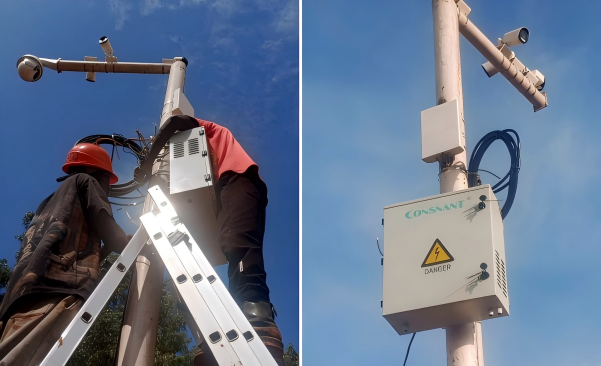
    Project Location: Burkina Faso Industry: Municipal Road Security & Surveillance Product: 1kVA Pole-mounted Outdoor UPS   Application: Backup Power for CCTV Surveillance   CONSNANT 1KVA pole-mounted Outdoor UPS was deployed for road surveillance in Burkina Faso. This all-in-one outdoor power cabinet mounts directly on camera poles, delivering uninterrupted power for monitoring cameras and transmission gear. It effectively addresses local grid outages & voltage fluctuations, adapting to West Africa’s hot, dusty tropical climate with simple installation and low maintenance.   Have outdoor surveillance, traffic or telecom projects facing unstable power? Contact CONSNANT team to get your customized outdoor UPS power proposal.    
  • New CNG112 Series Low Frequency Online UPS for Global IT & Industrial Critical Power Projects New CNG112 Series Low Frequency Online UPS for Global IT & Industrial Critical Power Projects Jun 06, 2026
    Introduction CONSNANT officially releases the brand-new CNG112 Series 4~20KVA Low Frequency Online UPS, optimized for single-phase critical power demand across global IT rooms, industrial automation, commercial office and small-scale data center projects. As an upgraded single-in single-out Low Frequency UPS, CNG112 integrates built-in isolation transformer, full-circuit protection and intelligent monitoring, delivering stable, clean backup power for precision electronic equipment in unstable grid environments worldwide.   Core Product Advantages of CNG112 4-20KVA Low Frequency UPS 1. Industrial Low-Frequency Transformer Design Equipped with internal isolation transformer as standard configuration, the CNG112 series features outstanding anti-surge and anti-interference performance, effectively filtering grid harmonic, voltage spike and waveform distortion. It remains stable in regions with poor power quality, a core advantage compared with conventional high-frequency UPS for harsh grid overseas projects. 2. Comprehensive Multi-layer Load Protection Complete protection mechanism including overvoltage, undervoltage, overload, short-circuit, over-temperature and lightning surge protection. When abnormal grid fluctuation or sudden blackout happens, the UPS instantly switches to battery mode to avoid unexpected shutdown and hardware damage of servers, PLC control hosts and monitoring equipment. 3. Optimized Battery Management System Customized charging algorithm for lead-acid storage batteries, realizing floating charge & equalized charge automatic switching, reducing overcharging damage and prolonging the whole battery service life. Flexible external battery configuration supports customizable backup runtime from tens of minutes to several hours to match diverse client project demands. 4. Intelligent Human-Machine & Remote Management Large LCD real-time display for input voltage, output parameter, battery status and fault code, facilitating on-site inspection and daily maintenance. Optional SNMP/RS485 communication module enables remote centralized monitoring via PC or cloud platform, ideal for centralized management of multi-set UPS deployed in branch office or distributed IT rooms. 5. Compact Mobile Cabinet Structure Equipped with wear-resistant universal casters, the vertical compact cabinet is easy for transportation, site placement and layout adjustment, saving installation space for narrow equipment room and small control cabinet scenarios.   Wide Application Scenarios of CNG112 Series The 4KVA~20KVA full power range covers diversified critical load fields: ✅ Small & medium-sized IDC computer room, server workstation and network equipment ✅ Industrial automation control system, PLC cabinet and production monitoring equipment ✅ Hospital outpatient office, banking terminal and retail commercial POS system ✅ Government office building, security monitoring and communication terminal equipment Perfectly fit overseas small-scale engineering bidding, system integrator matching and end-user facility renovation projects across Southeast Asia, Middle East, Africa and other emerging markets with unstable local power supply.   Why Choose CONSNANT CNG112 Low Frequency UPS? With decades of R&D and manufacturing experience in uninterruptible power supply, CONSNANT strictly implements ISO production standard for the whole CNG112 production line, from raw material incoming inspection to finished machine aging test. Besides reliable product quality, we provide global localized after-sales support, customized technical solution and flexible OEM/ODM service for worldwide distributors and project contractors. Ready to explore CNG112 power solution for your upcoming IT projects? Contact our sales team to get detailed datasheet, quotation and free technical consultation.  
  • CONSNANT CNG330 600KVA low-frequency online UPS applied in factories CONSNANT CNG330 600KVA low-frequency online UPS applied in factories May 22, 2026
    In today’s fast-paced manufacturing landscape, even a split-second power interruption can trigger costly production line shutdowns, damage high-value equipment, and lead to massive operational losses. For factories relying on heavy machinery, automated control systems, and continuous production workflows, power stability is non-negotiable. This is where the CONSNANT CNG330 600KVA Low-Frequency Online UPS emerges as the ultimate power protection solution, purpose-built to meet the most demanding industrial power requirements. Why Factories Need Industrial-Grade UPS Solutions Industrial environments are notorious for harsh power conditions: frequent voltage fluctuations, grid surges, harmonic distortion, and high inrush currents from motors, compressors, and welding equipment. Conventional power solutions often struggle to handle these challenges, putting critical operations at risk. The CNG330 series, with its low-frequency transformer-based architecture, is engineered to thrive in these settings, delivering robust, uninterrupted power to keep production moving.   Key Advantages of the CNG330 600KVA UPS for Factory Use 1. Built-in Isolation Transformer for Stable, Clean Power At the heart of the CNG330 lies an integrated isolation transformer, which provides complete electrical isolation from the mains. This feature effectively suppresses grid noise, voltage spikes, and EMI interference, delivering a pure sine wave output that protects sensitive PLCs, CNC machines, and automated control systems from damage. Unlike high-frequency UPS models, the transformer-based design ensures reliable performance even with non-linear and inductive loads common in factories. 2. Superior Overload & Short-Circuit Resistance Factory operations often involve sudden load surges—such as motor startups or heavy machinery activation. The CNG330’s industrial-grade design boasts exceptional overload capacity, capable of withstanding these high inrush currents without tripping. Its robust short-circuit protection ensures that downstream faults are cleared without disrupting power to critical systems, eliminating unplanned downtime caused by minor electrical anomalies. 3. Wide Voltage Input for Harsh Grid Conditions Many factories operate in areas with unstable power grids, where voltage can swing by ±20% or more. The CNG330 supports a wide input voltage range, eliminating the needfor additional stabilizers and ensuring continuous operation even in poor power environments. This adaptability makes it ideal for factories in remote locations or regions with inconsistent power infrastructure. 4. Low Harmonic Distortion & High Power Efficiency With low THDi (Total Harmonic Distortion) and a high power factor, the CNG330 minimizes harmonic pollution and maximizes energy efficiency. This not only reduces the risk of interference with other equipment but also lowers long-term energy costs for the factory, aligning with sustainability goals and operational efficiency targets. 5. Parallel Redundancy for Zero Downtime For factories requiring 100% uptime, the CNG330 supports N+1 parallel redundancy. Multiple units can be connected to share the load, ensuring that even if one UPS requires maintenance or experiences a fault, the remaining units continue to power critical operations. This modular scalability makes it easy to expand power capacity as the factory grows. 6. Low Maintenance & Long Service Life Designed with industrial-grade components and robust cooling systems, the CNG330 is built for durability. Its low-frequency architecture reduces component stress, leading to fewer failures and lower maintenance costs over its lifecycle. Combined with intelligent remote monitoring capabilities, factory managers can track performance, diagnose issues, and perform maintenance proactively, without disrupting production.   Real-World Impact: Protecting Factory Operations Consider a large manufacturing plant running 24/7 automated production lines. A single power flicker could halt production for hours, resulting in lost materials, labor, and revenue. With the CNG330 600KVA UPS in place: Production continuity is guaranteed, even during grid outages or fluctuations. High-value equipment (CNC machines, robotics, control systems) is protected from power-related damage. Operational costs are reduced through energy efficiency and minimal downtime. Safety compliance is maintained for critical systems that rely on stable power.   Conclusion: The CNG330 as Your Factory’s Power Backbone The CONSNANT CNG330 600KVA Low-Frequency Online UPS is more than just a power backup—it’s a strategic investment in your factory’s reliability, productivity, and profitability. Built to withstand the toughest industrial environments, it combines robust performance, efficiency, and scalability to meet the evolving power needs of modern manufacturing. Whether you’re operating a single production line or a sprawling industrial complex, the CNG330 series delivers the peace of mind that comes with knowing your power is always protected.   For more information on how the CNG330 600KVA UPS can be tailored to your factory’s specific power requirements, contact our team today for a customized solution and quotation.
  • CONSNANT alimente l'usine de fabrication de fenêtres et de portes de Yangon avec des solutions UPS fiables et un service sur site CONSNANT alimente l'usine de fabrication de fenêtres et de portes de Yangon avec des solutions UPS fiables et un service sur site May 06, 2026
     Solution d'alimentation sans coupure (UPS) personnalisée de 250 kVA pour le projet de nouvelle ligne de production de l'usine de fenêtres et de portes de YangonDepuis 2018, une importante usine de fabrication de fenêtres et de portes à Yangon, au Myanmar, fait confiance à CONSNANT pour ses besoins critiques en énergie, en déployant plusieurs ensembles de nos générateurs. Onduleur en ligne basse fréquence 250 kVA Des systèmes d'alimentation sans coupure (UPS) triphasés protègent les équipements de production essentiels. Récemment, nos techniciens se sont rendus sur place pour assurer la maintenance complète des systèmes UPS et fournir des conseils sur une nouvelle ligne de production, réaffirmant ainsi notre engagement à fournir une alimentation électrique fiable à notre partenaire de longue date. Un environnement énergétique local difficileLa centrale est située dans une région confrontée à de graves contraintes énergétiques :• Accès limité au réseau : seulement 4 à 6 heures d'alimentation électrique par jour.• Températures de fonctionnement extrêmes : la température intérieure de l'atelier peut atteindre 42 °C.• Protection des charges critiques : Les machines d'extrusion de l'usine, essentielles à son processus de fabrication, nécessitent une alimentation électrique continue pour éviter des temps d'arrêt coûteux, le gaspillage de matériaux et les retards de production.Ces conditions exigent des solutions d'alimentation sans coupure (ASI) robustes et résistantes aux hautes températures, capables de fournir une alimentation de secours stable et durable même dans des conditions difficiles. Nos systèmes ASI en ligne basse fréquence de 250 kVA, conçus avec des composants de qualité industrielle et fonctionnant sur une large plage de températures, répondent systématiquement à ces exigences depuis leur mise en service. Service sur site : Maintenance et solutions pour nouvelles lignesAu cours de cette visite, nos ingénieurs ont atteint deux objectifs clés pour soutenir les opérations du client :1. Maintenance préventive des systèmes UPS existants• Inspection complète et tests de performance des unités UPS de 250 kVA installées• Contrôles de l'état de la batterie, tests de banc de charge et étalonnage du système• Nettoyage des composants internes et vérification de l'efficacité du système de refroidissement, opérations essentielles dans un environnement d'atelier à haute température.• Documentation de l'état du système et recommandations pour des programmes de maintenance optimisésCes mesures proactives garantissent que les systèmes UPS existants continuent de fournir une alimentation de secours fiable aux machines d'extrusion de l'usine, minimisant ainsi le risque de pannes inattendues.2. Solution d'alimentation de secours personnalisée pour une nouvelle ligne de productionEn étroite collaboration avec l'équipe du client, nos ingénieurs ont conçu un plan de protection électrique sur mesure pour la nouvelle ligne de production :• Évaluation de la charge et analyse des besoins en énergie des nouveaux équipements• Recommandation pour des mesures supplémentaires CONSNANT 250 kVA Onduleur en ligne basse fréquence unités optimisées pour les besoins de fonctionnement prolongé de l'usine• Conseils sur l'agencement de l'installation, les exigences en matière de ventilation et l'intégration à l'infrastructure électrique existante de la centraleLa solution tire parti des principaux avantages de notre onduleur triphasé de 250 kVA :• Topologie basse fréquence avec une capacité de surcharge élevée et une forte adaptabilité aux réseaux instables• Conception de qualité industrielle avec protection intégrée contre les hautes températures, les fluctuations de tension et les environnements difficiles• Sortie triphasée pour une alimentation équilibrée des charges industrielles telles que les machines d'extrusion• Options de durée de fonctionnement évolutives pour répondre aux besoins quotidiens d'exploitation hors réseau de l'usineÉtablir des partenariats à long terme grâce à la fiabilité et au soutienCe projet témoigne du double engagement de CONSNANT : fournir des solutions UPS durables et performantes qui excellent dans des environnements difficiles, et assurer un support sur site réactif pour garantir le bon déroulement des opérations de nos partenaires.Depuis plus de six ans, nos systèmes d'alimentation sans coupure (UPS) en ligne basse fréquence de 250 kVA assurent le fonctionnement continu des lignes de production de l'usine de Yangon, même dans les conditions d'alimentation électrique les plus difficiles. Notre récente intervention a non seulement prolongé la durée de vie des équipements existants, mais a également jeté les bases de l'expansion future du client.Chez CONSNANT, nous ne nous contentons pas de fournir des solutions énergétiques, nous les accompagnons à chaque étape.
  • Sous-station intégrée intelligente : Système de stockage d'énergie à refroidissement liquide pour applications commerciales et industrielles Sous-station intégrée intelligente : Système de stockage d'énergie à refroidissement liquide pour applications commerciales et industrielles Apr 25, 2026
    Dans le contexte de la transition énergétique mondiale et de l’approfondissement de l’objectif « double carbone », le secteur commercial et industriel (C&I), maillon essentiel de la consommation d’énergie et de la réduction des émissions de carbone, a un besoin de plus en plus urgent d’énergies efficaces, sûres et… solutions intelligentes d'approvisionnement en énergieLa sous-station intégrée intelligente, associée à un système de stockage d'énergie à refroidissement liquide pour applications commerciales et industrielles, s'impose comme une solution clé. Elle intègre les technologies intelligentes de transformation, de distribution et de stockage d'énergie par refroidissement liquide. Elle surmonte les limitations des systèmes traditionnels d'alimentation et de stockage d'énergie et offre une garantie énergétique fiable, efficace et à faible émission de carbone aux utilisateurs commerciaux et industriels tels que les parcs industriels, les entreprises à forte consommation énergétique et les complexes commerciaux.  Principaux avantages :Épargne d'investissement♦ Conception de système intégré, pré-installation et pré-installationmise en service, réduction du nombre d'interventions sur siteajustements.♦ Contrôle intelligent de la température par IA, température du système différence ≤ 4 °C, réduire la puissance auxiliaire de 30 %consommationAmélioration de l'expérience utilisateur ♦ Conception de borne conviviale adaptable à différents types de fils exigences de jauge.♦ Niveaux de bruit opérationnel considérablement réduits, jusqu'à des niveaux aussi bas que 70 dB.Performances maximales♦ Conversion d'énergie à haut rendement par PCS multi-étapes technologie pour améliorer la charge et la décharge du systèmeefficacité jusqu'à 90 %.♦ Les algorithmes d'optimisation de l'IA dans le cloud facilitent la prise de décision. base sur des prévisions de haute précision pour les systèmes complexes opérations et transactions sur le marché de l'électricité, qui peuvent augmenter le chiffre d'affaires annuel de 15 % à 20 % et raccourcir lecycle de retour sur investissement.Exploitation et maintenance intelligentes♦ Surveillance en ligne intelligente, détection rapide des états et des défauts Enregistrement permettant une localisation et une analyse rapides des pannes du système.♦ Prend en charge le fonctionnement et la maintenance à distance, avec une intelligence embarquée Exploitation et maintenance améliorant l'efficacité de la station de stockage d'énergieopérations, rendements des actifs et revenus des services. En termes de scénarios d'application, ce système intégré présente une grande adaptabilité et peut être largement utilisé dans divers secteurs commerciaux et industriels. Dans les parcs industriels, il permet de répondre aux besoins élevés et stables en énergie des équipements de production à grande échelle, d'optimiser la répartition de l'énergie et de réduire les coûts de production. Dans les entreprises à forte consommation énergétique, telles que les industries manufacturières et chimiques, il contribue à alléger la pression sur les factures d'électricité grâce à l'écrêtement des pointes et au lissage des creux de consommation, et aide les entreprises à atteindre leurs objectifs d'économie d'énergie et de réduction des émissions. Dans les complexes commerciaux et les immeubles de bureaux, il fournit une alimentation de secours fiable afin d'éviter les pertes économiques dues aux coupures de courant, tout en optimisant la structure énergétique et en réduisant les émissions de carbone. Pour mieux mettre en évidence les principaux avantages de refroidissement liquide système de stockage d'énergieNous résumons ici ses avantages par rapport aux systèmes de stockage d'énergie traditionnels (représentés par les systèmes à refroidissement par air) : il offre d'excellentes performances de contrôle de la température, avec une différence de température des cellules de la batterie contrôlée à ±5 °C près et une efficacité de refroidissement pouvant atteindre 95 à 98 % ; sa consommation d'énergie est réduite de 50 à 60 % par rapport aux systèmes à refroidissement par air ; il peut prolonger la durée de vie de la batterie jusqu'à 20 %, réduisant ainsi les coûts d'exploitation et de maintenance ; et il offre une protection de sécurité plus fiable, avec un niveau de protection de l'armoire IP54 ou supérieur, ce qui lui permet de s'adapter aux environnements difficiles. Optez pour notre sous-station intégrée intelligente avec système de stockage d'énergie à refroidissement liquide pour applications commerciales et industrielles et profitez d'un avenir énergétique plus efficace, plus sûr et plus écologique pour votre entreprise. Contactez-nous dès maintenant pour des solutions personnalisées ! 
  • Différences et avantages : Redresseur à 6 impulsions vs redresseur à 12 impulsions pour onduleur industriel en ligne Consnant Différences et avantages : Redresseur à 6 impulsions vs redresseur à 12 impulsions pour onduleur industriel en ligne Consnant Apr 17, 2026
    En fonction des scénarios d'application de Onduleur industriel en ligne Consnant série CNILes principales différences entre les onduleurs à 6 impulsions et à 12 impulsions résident dans la structure du redresseur, la capacité de suppression des harmoniques, la compatibilité avec le réseau et le coût global. L'onduleur à 12 impulsions offre une compatibilité réseau, une stabilité et une efficacité supérieures, le rendant adapté aux environnements industriels difficiles ; l'onduleur à 6 impulsions, quant à lui, se distingue par son faible coût et sa structure simple, le rendant adapté aux applications standard. 1. Différence structurelle fondamentaleRedresseur à 6 impulsionsUtilise une topologie en pont complet à 6 SCR, générant 6 impulsions de courant par cycle CA. Conception simple, format compact, coût réduit. Redresseur à 12 impulsionsÀ partir du redresseur à 6 impulsions, un transformateur déphasé et un deuxième pont redresseur à 6 impulsions sont ajoutés, pour un total de 12 thyristors.Le transformateur décale la phase de la tension d'entrée de 30°, et les deux ponts sont connectés en parallèle et superposés pour former 12 impulsions/cycle.Structure plus complexe, fiabilité accrue pour une utilisation industrielle. 2. Comparaison des principales caractéristiques de performance de Onduleur industrielArticle6-Impulsions12 impulsionsAvantageTHDi d'entrée~25%–30%~8%–10%12 impulsionsFacteur de puissance (PF)~0,8>0,9512 impulsionsProfil harmoniqueDominée par les harmoniques de 5e et 7e rangLes harmoniques de 5e et 7e ordre sont en grande partie annulées.12 impulsionsImpact sur le réseauPeut provoquer une surchauffe, des interférences et une instabilité du générateur.Pollution minimale du réseau12 impulsionsEfficacitéLégèrement plus élevéLégèrement inférieur (pertes du transformateur)6-ImpulsionsTaille et poidsPlus petit, plus légerPlus grand, plus lourd6-ImpulsionsCoûtInférieurPlus haut6-ImpulsionsRedondancePont simplePont double, capacité de charge partielle en cas de défaillance d'un pont12 impulsions 3. Principaux avantages de la transmission à 12 impulsions par rapport à la transmission à 6 impulsions (scénarios industriels) a. Harmoniques ultra-basses, compatibles avec le réseau électriqueSupprime significativement les harmoniques de bas ordre 5 et 7 (une cause majeure de pollution du réseau).THDi
  • Onduleur triphasé haute fréquence en ligne CONSNANT : une protection fiable de l’alimentation pour les applications critiques de petite et moyenne envergure Onduleur triphasé haute fréquence en ligne CONSNANT : une protection fiable de l’alimentation pour les applications critiques de petite et moyenne envergure Apr 11, 2026
    À l’ère actuelle de la numérisation et de l’industrialisation rapides, la demande en alimentation électrique stable dans les environnements critiques de petite et moyenne envergure — tels que les petites salles de serveurs, les systèmes de contrôle industriels et les installations commerciales — est devenue de plus en plus forte. Même des coupures de courant momentanées ou des fluctuations de tension peuvent entraîner des pertes de données, des dommages matériels et des pertes financières. Onduleur triphasé haute fréquence en ligne CONSNANT 10–20 kVA est conçu sur mesure pour répondre précisément à ces besoins, en utilisant des performances fiables et à haut rendement pour renforcer la protection de l'alimentation électrique des équipements critiques. Pour les projets de construction de centres de données et de salles d'équipements d'usine au Moyen-Orient, nous avons produit en série des unités UPS en ligne haute fréquence de 10 kVA, en les configurant avec des systèmes d'alimentation de secours par batterie correspondants, conformément aux exigences spécifiques du client.Conçu spécifiquement pour les charges de petite et moyenne intensité, cet onduleur triphasé présente des avantages majeurs : sa topologie à double conversion en ligne garantit un temps de transfert nul, isolant efficacement les équipements des perturbations du réseau telles que les surtensions, les harmoniques et les fluctuations de fréquence. Il assure ainsi une alimentation continue en courant sinusoïdal pur et propre. De plus, sa technologie de contrôle numérique DSP avancée régule avec précision la tension et la fréquence, améliorant la stabilité et la réactivité du système. Enfin, ses fonctions d'autodiagnostic intelligent et de protection contre les défauts contribuent à réduire les coûts d'exploitation et de maintenance. Ce produit allie haute performance et simplicité d'utilisation. Avec un rendement de 90 à 94 %, optimisé par la correction active du facteur de puissance (PFC), il minimise le gaspillage d'énergie et réduit les coûts d'exploitation. Son format compact et léger le rend idéal pour les espaces restreints, tandis que sa compatibilité avec les configurations tour et rack offre la flexibilité nécessaire pour répondre à diverses exigences de déploiement. De plus, une large plage de tension d'entrée, un système intelligent de gestion des batteries et des options de surveillance à distance renforcent encore sa praticité et sa fiabilité. Que ce soit pour les petits centres de données périphériques, les équipements d'automatisation industrielle, les systèmes de point de vente commerciaux ou les instruments de laboratoire médical, le CONSNANT 10–20 kVA Onduleur triphasé haute fréquence en ligne Elle assure une alimentation électrique continue 24h/24 et 7j/7. Grâce à un excellent rapport performance/prix, elle permet aux entreprises de limiter les risques liés à l'alimentation électrique et de garantir le fonctionnement continu et stable de leurs systèmes critiques. 
1 2 3 4 5

A total of5pages

Besoin d'aide? Discute avec nous

laisser un message
Si vous êtes intéressé par nos produits et souhaitez en savoir plus, veuillez laisser un message ici, nous vous répondrons dès que possible.
soumettre
CONTACTEZ-NOUS #
0086 13501592453

Nos horaires

Lun 21/11 - Mer 23/11 : 9h00 - 20h00
Jeu 24/11 : fermé - Joyeux Thanksgiving !
Ven 25/11 : 8h00 - 22h00
Sam 26/11 - Dim 27/11 : 10h - 21h
(toutes les heures sont en heure de l'Est)

Maison

Des produits

whatsApp

contact

Start a Conversation

Hi! Click one of our members below to chat on